Tactile grounding tools
Something steady to hold onto, in a room that isn't.
ANCHOR is two palm-size tiles I made to help a body settle: a spiral to press and trace, and a square path to breathe along. No power, no screens, no setup.
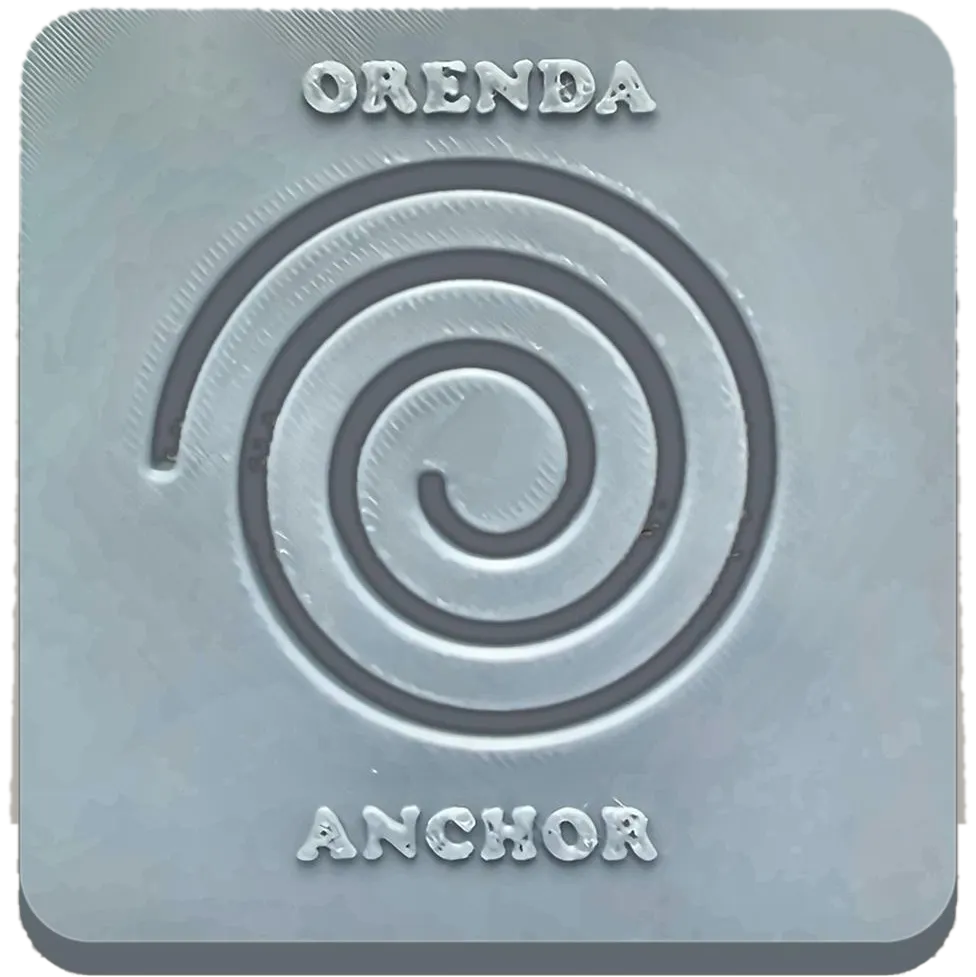
Need a moment? Try the spiral press
Spiral press
The newest spiral has a spring. The coil lifts out of the tile, gives under your thumb, and rises back when you let go. Tension, then release.
- Rest your thumb on the center of the spiral.
- Press slowly as you breathe in, and feel it give.
- Hold for a moment and notice the pressure.
- Let go as you breathe out, and feel it rise back.
- Repeat as many times as you need.
Press and hold the spiral.
This is a practice version. The tile is meant to be held.
From someone who has been there.
I’ve been the patient in the hospital bed and the family member in the chair. I know, from the inside, what it costs a person to be left to regulate alone. Now I sit beside people in those moments as a volunteer crisis responder and in the ICU, and ANCHOR is what I bring with me.
A small tool for big moments. You are not alone.
Read my story →Where to start
- Meet the toolsTwo palm-size tiles: a spiral to press and trace, and a square path to breathe along.
- Try it nowPractice box breathing and spiral tracing right here on the screen.
- The ICU practicumHow ANCHOR is being offered at Mission Hospital this fall.
- Tell me how it wentWere you handed a tile or a card? Share what it was like. It takes about two minutes.
What's known, and what isn't yet
Early bedside signals aren't proof. Here is how strong each part of the case is.
- StrongestPractical fitSweat, one hand, cleaning. Anyone can see it work.
- StrongPrecedentSome ICUs already include fidget tools in delirium care. It's a common practice, not yet a tested one.
- StrongSlow breathingWell studied. Slow breathing raises heart rate variability in the short term.
- ModeratePressure inputUsed in occupational therapy. The studies are few and small.
- EmergingCompleting activationA framework that is still being studied.
Where care becomes tangible
Watch · 4 min 44 sec
A short film about why ANCHOR exists, how the spiral came to be, and what the bedside has taught it.
Read the transcript
What helps a body find its footing when everything around it is beeping, moving, and uncertain? ANCHOR was made to answer that.
An ICU room holds three nervous systems under stress: the patient, the family, and the people caring for them. Very little tends to all of them at once. And the ICU’s impact rarely ends at discharge. Up to 75% of patients experience delirium, and many survivors and their families carry lasting effects known as post-intensive care syndrome.
The person behind ANCHOR has been both the disoriented patient in the hospital bed and the worried family member in the chair. She knows how little there is to hold onto, during the stay and long after it. So she created ANCHOR, a palm-size grounding tool to press, trace, and breathe with. It works with one hand, with sweaty hands, and it cleans between every use.
This tool is designed to be something small enough to hold, and made for one of the hardest places to be. ANCHOR stands for Attunement, Nervous system, Connection, Healing, Orenda, and Reciprocity. Orenda is the Haudenosaunee understanding of the vital life force that all beings carry.
The spiral concept began as a raised ridge, then one spiral print came out with a little give, a mistake. But when clinicians pressed it, recognition was instant. The raised spiral needed explaining. This one explained itself, and it became the form ANCHOR takes today.
The spiral material evolved as much as the shape. The first print was clear and glass-like: beautiful, but not beneficial. Then came an ultra-pliable version that felt soft in the hand, but it held onto germs, and in an ICU that ends the conversation. The form ANCHOR takes today are printed in PLA, a rigid, plant-based plastic made from renewable sources like corn starch. It resists water and sweat, wipes clean, and keeps its shape under pressure.
ANCHOR’s case is built honestly, from the ground up. Its strongest claim is its practicality. It rests on solid precedent, since ICUs already use fidgets in delirium care, and on slow, paced breathing, which is well studied for calming the heart. Pressure input has support in occupational therapy. And the idea that pressing can help the body complete stuck activation is an emerging framework, still being studied. Early bedside signals aren’t proof, but they’re a strong reason to keep going.
The design was also informed by direct bedside observation. A patient called the spiral a fidget, and suddenly it felt familiar instead of clinical. A daughter kept her spiral after using it at her father’s bedside. Nurses and doctors passed on tiles handed to them, but might reach for ones left quietly within reach. And when they do reach for one, it slips right into a scrub or coat pocket. Every lesson is now part of the design, and ANCHOR is patent pending.
In the ICU, so much is out of your hands: your body, your time, the people you love. ANCHOR gives something back. Something to press when fear rises. Something to trace while you wait. Something that holds steady when nothing else does. Healing isn’t always something to seek out. Sometimes, it’s right in the palm of your hand.